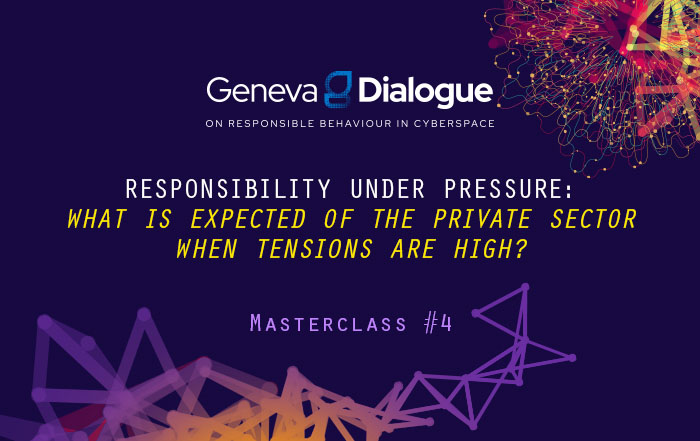
2026 Geneva Dialogue Masterclass #4
When: 4 December 2026, 15:00 – 17:00 CET
Location: Registration https://diplomacy.zoom.us/webinar/register/WN_frahdK7vSr2SBV4aQyUSUA#/registration
Description
Cyber norms and confidence-building measures were designed with states in mind. When tensions rise and conflicts escalate, however, companies are often the first to see what is happening and the first to respond. Governments also turn to them for help, whether as vendors, infrastructure operators, cloud and hosting providers or developers of AI.
States remain responsible for national security, international law and the use of force. Yet the technologies behind these decisions are increasingly built and controlled by private companies. Their roles, resources and exposure vary widely, and they face diverging expectations across jurisdictions. Some governments are also exploring new forms of cooperation with industry, including government-authorised operations.
As cybersecurity shifts towards a contest between intelligent systems supervised by humans, escalation can happen at machine speed. That leaves little time for consultation, attribution or diplomacy. The question is no longer only what states do, but who else wields influence, who is expected to do what, and who answers for the outcome.
This masterclass asks what is expected of the private sector in such settings, whatever stage a conflict has reached. It brings together perspectives from national cybersecurity agencies, diplomacy, industry and the security research community to explore:
- whether agreed cyber norms can translate into practical cooperation when tensions run high;
- how responsibility should be understood across different types of private actors;
- what shared practice between governments, companies and the wider international community would build trust and predictability without constraining innovation.
Format
A moderated roundtable on Zoom. Lead discussants will open with short framing statements on how their understanding of the private sector’s role in high-tension situations has changed over the past year. The conversation will then widen to participants from across non-state communities, including critical infrastructure operators, cybersecurity professionals, industry, open-source contributors, compliance specialists, policy experts, academia and civil society.
The discussion is organised around three themes:
- The changing context and the actors
- Responsibility and norms under pressure
- Large technology companies and international governance
Context
The session is part of the Geneva Dialogue’s 2026 focus on stress-testing cybersecurity practices and agreed cyber norms under real-world conditions. Its findings will inform the next chapter of the Geneva Manual on Responsible Behaviour in Cyberspace.